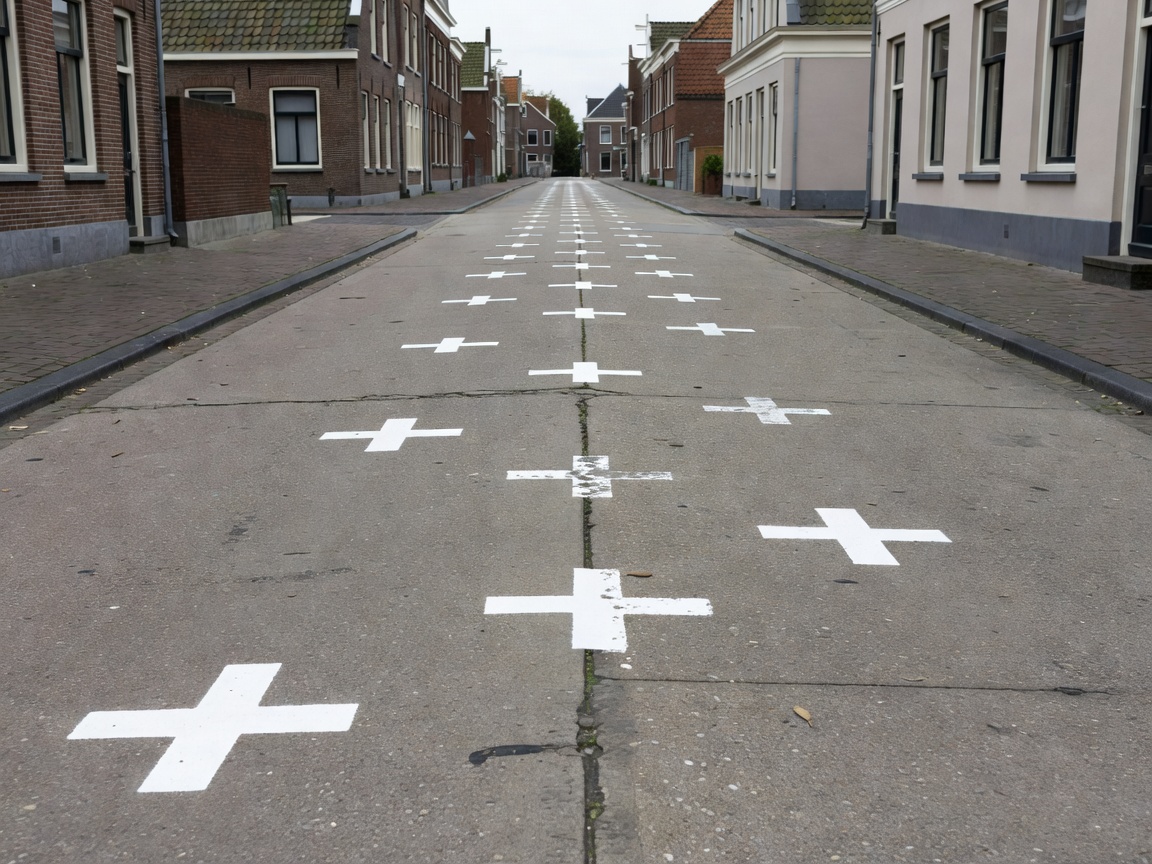
Nowhere else on the planet is the concept of a national border as chaotic, intimate, and delightful as in the twin municipality of Baarle-Hertog (Belgian) and Baarle-Nassau (Dutch). Here, crossing the street can require stepping between two different countries four separate times.
Medieval Land Swaps and Feudal Politics
The baffling boundary labyrinth dates back to 1198, when Henry I, Duke of Brabant, leased several parcels of farm and marsh land to Godfried II of Schoten, Lord of Breda. The Duke retained all the parcels where his loyal vassals paid direct taxes (which evolved into Belgian Baarle-Hertog), while the leased estates became Dutch Baarle-Nassau.
When Belgium formally declared independence from the Kingdom of the Netherlands in 1830, cartographers and royal commissions attempted to draw a continuous, logical boundary. After 15 years of fierce local pushback from landowners whose crops sat across different jurisdictions, the 1843 Treaty of Maastricht gave up and officially recognized all 22 distinct Belgian parcels as sovereign Belgian soil entirely enclosed within the Netherlands.
The "Front Door Rule" (Voordeurregel)
Because the border slices directly through residential buildings, shops, and restaurants, Dutch and Belgian authorities instituted the pragmatic Front Door Rule: your house, tax obligations, and municipal residency belong to whichever country contains your front door. If the border runs straight through the middle of the front door, the residence receives two separate street numbers and two mailboxes with distinct national flags.
Counter-Enclaves: Enclaves Inside Enclaves
The cartographic strangeness doesn't end at 22 Belgian islands. Inside those Belgian enclaves, there exist seven Dutch counter-enclaves (second-order enclaves). A person standing in the smallest of these counter-enclaves—an unremarkable patch of grass measuring barely 2,600 square meters—is in the Netherlands, entirely surrounded by Belgium, which is in turn entirely surrounded by the Netherlands.
During differing COVID-19 lockdown restrictions and closing hours between the Dutch and Belgian governments, diners at local restaurants famously shifted their chairs from one side of the dining room to the other at 10:00 PM to continue drinking legally under the more lenient country’s curfew laws.